
Should-cost in 8 blocks
Material grade, moulding line, complexity, cores, volume and foundry country. See how geometry, cores and process choices move €/kg – before the RFQ. EUR per kg and per part, with a PDF report.
CastCalc · by Osturu Consulting
CastCalc works out the should-cost of your iron castings: what a fair foundry would charge, split into metal, sand and cores, energy, labour, equipment, overhead and profit, with this month's prices for the foundry's country.
All features for 30 days. No card needed, company e-mail required.
Energy prices are updated monthly from market data for 17 European markets; for the USA, Japan, China, Turkey and India they are fixed values until monthly sources are added.
How buyers use it
Everything you save is tracked, so you can prove it to your management.
Get a target price before you send the RFQ, and put it in the request.
See at once whether the quote is fair, how far above should-cost it is per kg, per part and per year, and which cost blocks to question.
Check the foundry's claim against the market data with the 5-Step Price Challenge and answer with numbers, not opinions.
Built for procurement and engineering teams at automotive OEMs, industrial OEMs, machining suppliers and industrial suppliers that buy grey and ductile iron castings. Steel, aluminium and 3D sand printing are available on request.
What is inside
Material grade, moulding line, complexity, cores, volume and foundry country. See how geometry, cores and process choices move €/kg – before the RFQ. EUR per kg and per part, with a PDF report.
The gap to should-cost in EUR/kg, per part and per year. Compare the supplier's cost breakdown block by block and see where to negotiate first.
Decompose the claim, verify the market drivers, read the relationship signals, benchmark and counter. With a shareable assessment PDF.
Saved parts are priced again with each monthly data update: change since saved, month on month and year on year, explained by cost block.
Price increases avoided and prices negotiated down, per supplier and year, as a report for your management.
How casting costs move month by month, the same part priced in other countries, and a directory of foundries by country and material.
No black box
A should-cost is what a well-run foundry in the chosen country needs to charge for your part. CastCalc adds it up block by block, the way a foundry cost engineer does, and shows every block.
| Cost block | How it is calculated, in plain words |
|---|---|
| Metal | Price of the charge for the grade (steel scrap, returns, briquets, pig iron, alloys) per kg of liquid metal, divided by the yield: you pour more metal than you ship. Gates and feeders go back to the furnace as returns and are credited, never more than the metal cost. |
| Sand, cores & consumables | Moulding sand, cores, coatings, filters, feeders, temperature probes and lining wear per mould, shared by the castings in the mould and adjusted for yield and scrap. |
| Energy | kWh to melt the poured metal (scrapped castings included) plus plant energy, times the industrial energy price of the foundry's country. |
| Labour | The moulding-line crew per casting plus fettling and grinding minutes, times the labour cost of the country. |
| Heat treatment | Furnace energy per kg, only when the part needs it. |
| Equipment | Yearly depreciation of the line and pattern, divided by the castings the line makes in a year (moulds per hour × cavities). |
| Overhead | A share of the costs above for plant overhead, quality and logistics; it depends on the line and the annual volume. |
| Profit | The margin on top (10% unless you set another). |
Prices are updated every month from published market sources: steel scrap from the ACO price index, copper and nickel from the LME, ferro-alloys from Foundry Trade Journal, industrial electricity from the day-ahead power exchanges for 17 European countries (fixed values for the USA, Japan, China, Turkey and India), and the ECB exchange rates. Labour costs per country are reviewed regularly. Every result shows the month of its data.
The basics are weight, grade, moulding line, complexity, cores, cavities, annual quantity and the foundry's country. The advanced parameters (yield, scrap, moulds per hour, grinding time, energy and labour rates, overhead, margin) let you mirror a specific supplier's setup, so you can test what their quote assumes.
Worked example
The practice part in CastCalc: a ductile iron bracket (GJS 400-15, 8 kg), vertical moulding line, 2,000 pieces a year, priced with sample data. The supplier quotes €2.35/kg.
Should-cost €2.05/kg. The quote is 15% above: €0.30/kg, €4,791 a year. A total price alone cannot show which block is too high, so CastCalc drafts the request for the supplier's cost breakdown.
Entered next to the should-cost, block by block. The gaps (example):
| Block | Should-cost | Supplier | Gap |
|---|---|---|---|
| Energy | 0.32 | 0.45 | +0.13 |
| Overhead | 0.26 | 0.36 | +0.10 |
| Metal | 0.59 | 0.62 | +0.03 |
| Sand, cores | 0.41 | 0.43 | +0.02 |
| Labour, equipment, profit | 0.47 | 0.49 | +0.02 |
Energy (+€0.13/kg): ask for their energy price per kWh and the kWh per kg. Overhead (+€0.10/kg): ask what is in it; it should fall as the volume rises. Then log the quotes, your counter and the final price on the part page: the saving is counted in Savings proven.
Supplier breakdown and prices are an example; the gaps and hints are CastCalc's output for these numbers.
See it
Screens from the current version, with a sample account (fictional parts and suppliers).
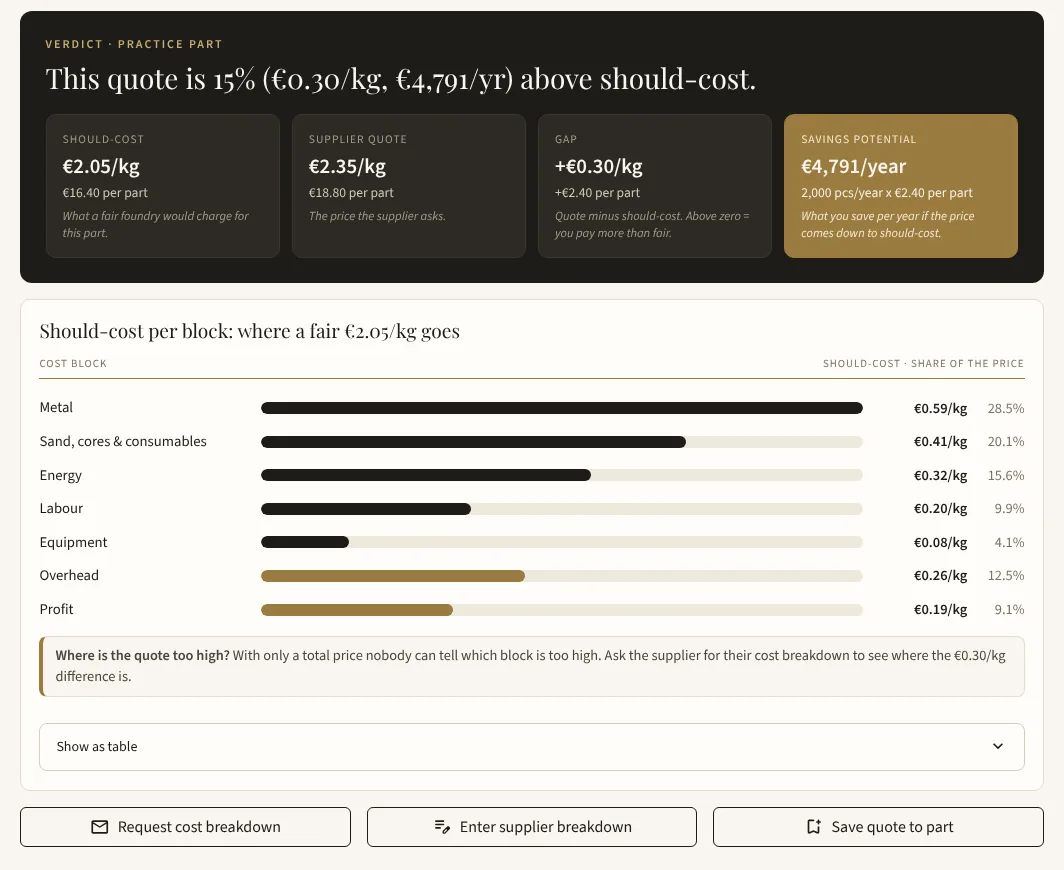
Enter the supplier's price per kg and get the verdict in one sentence: the gap per kg, per part and per year, and the should-cost of every cost block. Then ask for the supplier's breakdown and see where to negotiate first.
Sample data.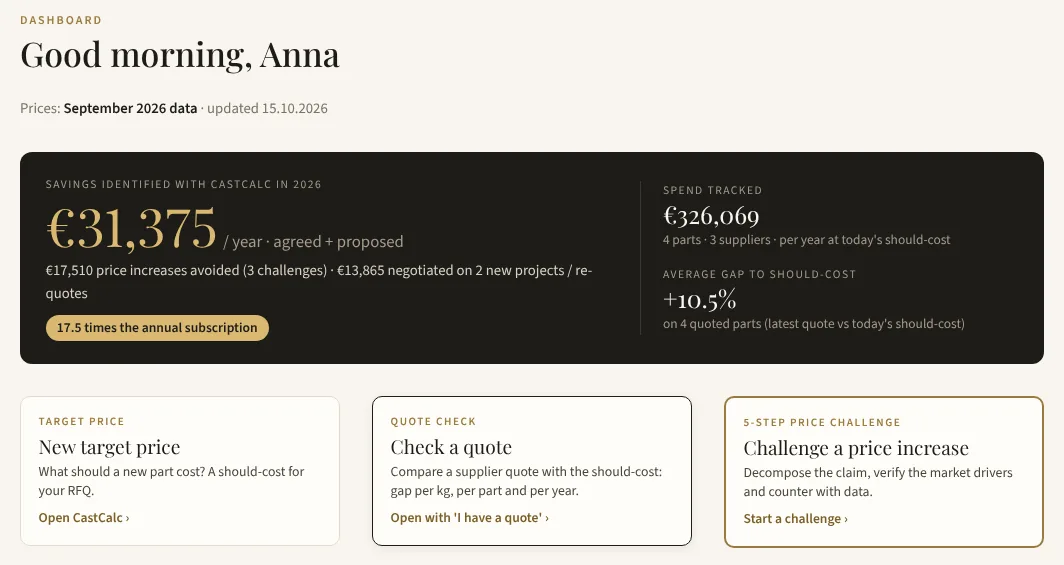
The Dashboard adds up the price increases you avoided and the prices you negotiated down, the spend you track and how far your suppliers' quotes are above should-cost.
Sample data.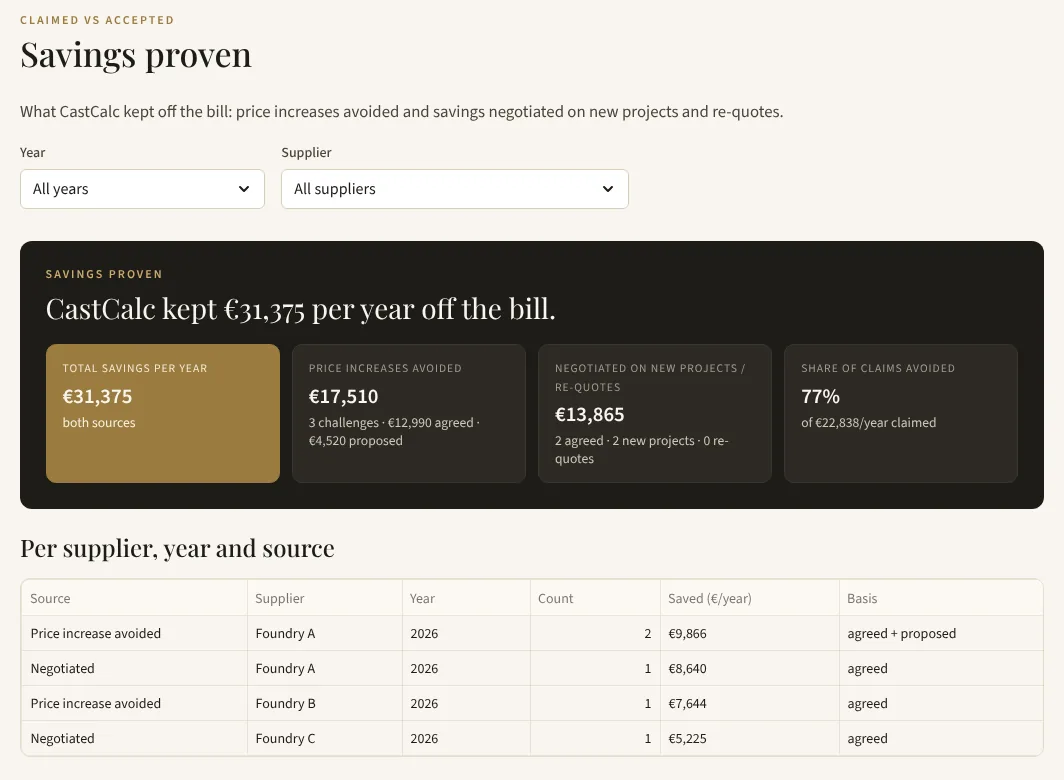
Every challenge and negotiation, per supplier and year, agreed or proposed, as a report for your management.
Sample data.Foundry practice, not a black box
Luka Plahuta, metallurgical engineer, worked on the foundry floor and as quality director at Livar (IATF 16949, a team of 25+), then moved to sourcing. CastCalc's cost model follows how a foundry really calculates: metal and charge, sand and cores, energy, labour, equipment, overhead and profit.
Every number can be traced back to its cost block, and the market data is updated with each monthly price update.
Plans
Start with 30 days of every feature. Then choose a plan, or keep the free view.
Stay informed after your trial.
Free forever. Your data stays.
Start 30-day free trialEverything a casting buyer needs. One user.
€1,790 billed once a yearBilled monthly, cancel anytime
Start 30-day free trialPay by card
For buying teams that share their parts.
€4,990 billed once a yearBilled monthly
Book a demoPrices without VAT (seller not registered for VAT; EU business customers get a reverse-charge note). Team billed annually can also be paid by invoice. 5 Professional licences would cost €8,950 a year.
| Feature | Free | Professional | Team |
|---|---|---|---|
| Calculations | |||
| Should-cost calculations | – | Unlimited | Unlimited |
| Quote check (gap and savings per year) | – | ✓ | ✓ |
| Advanced parameters | – | ✓ | ✓ |
| Should-cost PDF report and CSV | – | ✓ | ✓ |
| Calculation history | Read-only | ✓ | ✓ |
| Negotiation | |||
| 5-Step Price Challenge | – | ✓ | ✓ |
| Price increase assessment (PDF) | – | ✓ | ✓ |
| Savings proven tracker | – | ✓ | ✓ |
| Market data | |||
| Market Index | ✓ | ✓ | ✓ |
| Foundries directory | ✓ | ✓ | ✓ |
| Saved parts | Read-only | ✓ | ✓ |
| Live prices, MoM / YoY on your parts | – | ✓ | ✓ |
| Team & support | |||
| Users | 1 | 1 | Up to 5 |
| Onboarding: live online session | – | – | ✓ |
| Consulting hours with Luka Plahuta (workshops, design reviews, RFQ support) | – | – | 10 h/yr |
| Quarterly price review with Osturu | – | – | ✓ |
| Priority support | – | – | ✓ |
| Pay by invoice | – | – | ✓ |
Done for you
A structured, expert-led review of your casting portfolio – focused on spend, price benchmarks, design cost flags, and a concrete action plan. Delivered as a written report.
Scoped to portfolio size · excl. VAT. Typical delivery: 3–5 working days after data receipt.
Request an auditWebinars
How should-cost works for iron castings, how to read a foundry price increase, and how to answer it. Leave your e-mail and we tell you when the next date is set. Webinars for your own buying team are available on request.
CastCalc showed a meaningful accuracy gap where our previous reference tool significantly overestimated cost on larger parts. The CastCalc benchmark landed within 5% of our actual supplier pricing – which is exactly what we need to negotiate with confidence.
Questions
Your account switches to Free: Market Index, Foundries and your saved parts stay available read-only. Calculations, live prices and the Price Challenge return as soon as you choose a plan. Nothing is deleted.
Yes. Monthly plans are cancelled in the billing portal with one click. You keep full access until the end of the period you paid for; after that your account switches to Free and your data stays.
Team starts with a live online session with Luka Plahuta, built around your own parts and price increases: how to calculate a should-cost, check a quote, run the 5-Step Price Challenge and report the savings.
Team includes 10 consulting hours per subscription year (worth €1,200 at €120 per hour), on top of the live online onboarding. Use them for workshops with your team, design reviews or RFQ support. Unused hours expire at the end of the subscription year.
Grey and ductile iron sand castings are the core. Steel, aluminium and 3D sand printing are available on request: write to us.
Yes, for Team billed annually. Professional and monthly plans are paid by card through Stripe.
Invoices are issued by BPLP Consulting, Barbara Plahuta s.p., Slovenia, which is not registered for VAT, so no VAT is added. EU business customers get a reverse-charge note with both VAT IDs; Slovenian customers get the note under Art. 94(1) ZDDV-1.
Card payments are handled by Stripe; card details never reach CastCalc. Your calculations and price challenges are visible only to your login, shared parts only to your Team, and we never share your data with foundries. See the Privacy Policy.
Be ready with the should-cost. Or book a free 15-minute evaluation: no drawings needed, we run your part through CastCalc and show the cost drivers.